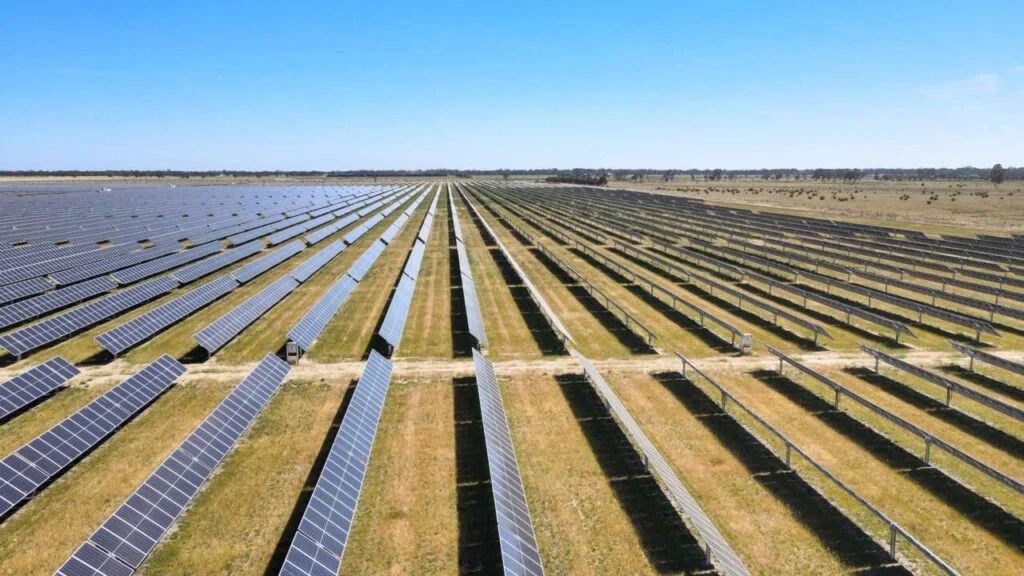
More than 3.8GWh of combined BESS capacity has either cleared or is undergoing federal environmental assessment under Australia's EPBC Act.
Why it matters: Midday solar prices are hitting zero across the EU; Australia’s shift to 4-hour storage is the blueprint you need to stop your projects from becoming economically obsolete.
Flick AI is a CRM for solar installers: the AI answers WhatsApp leads in seconds, builds proposals with automatic panel layouts and books the site visit. See how it works.
Australia is essentially a time machine for the European energy transition. While many installers in Portugal and Spain are still high-fiving over 1-hour duration residential batteries, this 3.8GWh pipeline in Australia confirms the brutal reality of a solar-heavy grid: power is cheap, but energy shifting is everything.
The 4-Hour Standard is the New Minimum
Look at the ratio in these Australian projects. We aren't seeing 500MW/500MWh systems anymore. The industry is moving toward a 1:4 power-to-energy ratio. Why? Because the 'duck curve' has become a 'canyon.' In markets like South Australia—and increasingly in Iberia—midday solar generation drives wholesale prices to zero or even negative. A 1-hour battery is a tactical tool for frequency response (FCR); a 4-hour battery is a strategic asset for energy arbitrage.
The Margin Shift
We’ve seen this pattern before. In 2021, everyone chased EPC margins on pure PV. In 2024, those margins are razor-thin. The real money in 2025/26 will be in the integration of long-duration storage. When a Portuguese textile factory asks why their 1MW solar array isn't saving them money during the evening shift, a 1MWh battery won't be the answer. You'll need the 4MWh 'Australian-style' approach to actually move that cheap midday electrons to the 8 PM peak.
Stop thinking about batteries as a 'backup' or an 'add-on.' In a world of €0.00/MWh solar peaks, the battery is the product, and the solar panels are just the fuel supply.