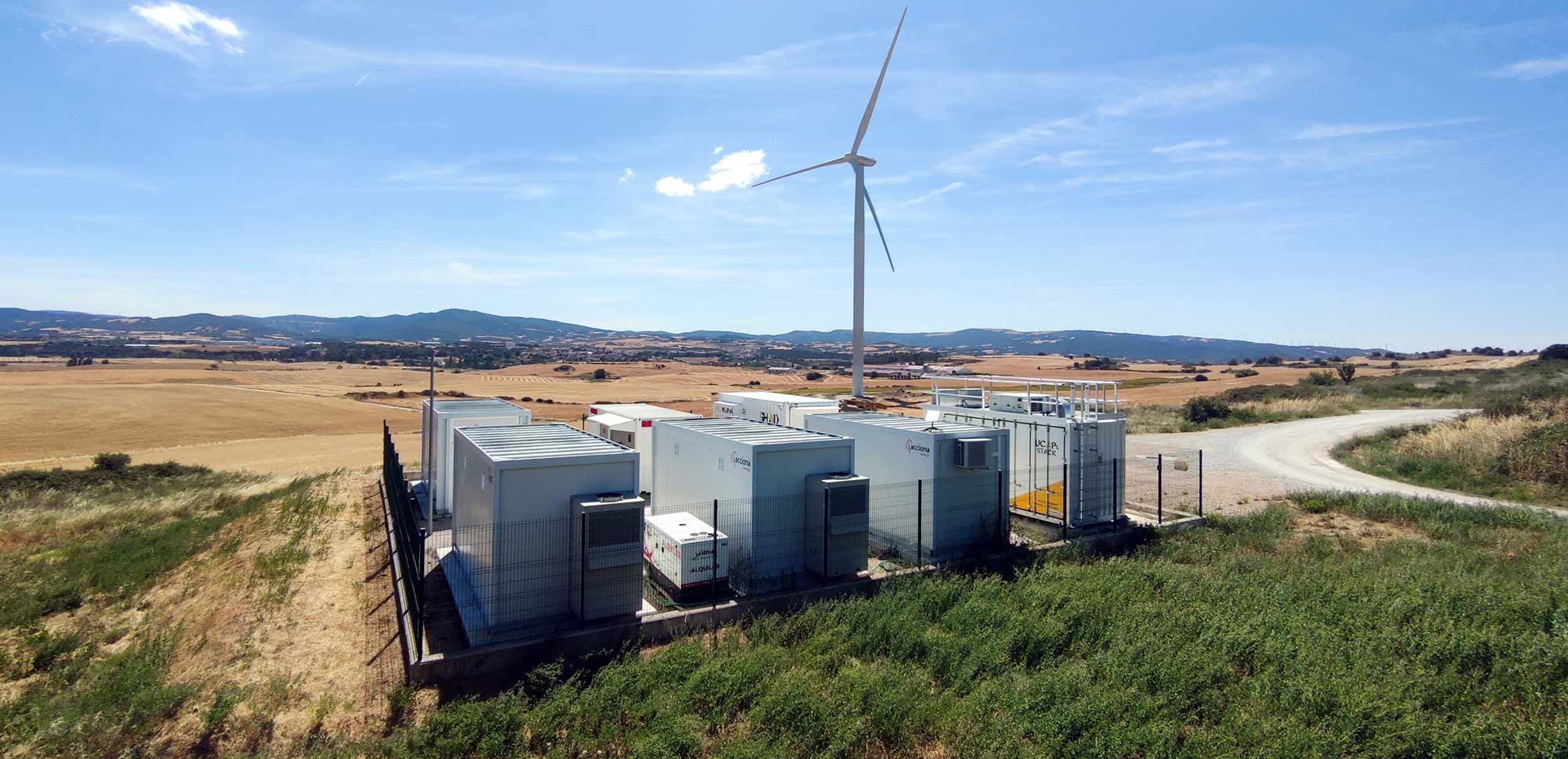
pretende demostrar que las plantas fotovoltaicas pueden asumir funciones de estabilidad que tradicionalmente eran desempeñadas por las centrales térmicas convencionales.
Why it matters: As the Iberian spot market crashes, your project's survival depends on selling frequency stability services that standard batteries can't handle alone.
Flick AI is a CRM for solar installers: the AI answers WhatsApp leads in seconds, builds proposals with automatic panel layouts and books the site visit. See how it works.
Everyone in the Iberian market is currently obsessed with 2-hour and 4-hour LFP battery durations to solve the afternoon price cannibalization. They’re missing the real bottleneck: grid inertia. When a gas turbine in Tarragona trips, the grid loses physical spinning mass. Traditionally, solar has been a 'dumb' follower, but Acciona’s move into ultracapacitors (UCs) in Navarra is the first serious attempt to prove that PV can finally kill the gas peaker's last excuse for existing.
The LFP Warranty Trap
If you've ever looked at the fine print of a 10-year BESS warranty from the likes of Sungrow or Huawei, you know they hate rapid, shallow cycles. Using a standard lithium-ion stack for Fast Frequency Response (FFR)—the kind of split-second adjustments needed when grid frequency dips below 50Hz—is a surefire way to cook your cells and void your performance guarantees. This is where ultracapacitors come in. They handle the 'heartbeat' of the grid (high power, low energy) while the batteries handle the 'shifting' (low power, high energy).
Follow the Money: Ancillary Services
For a developer in Spain or Portugal, this isn't just a science project. Red Eléctrica (REE) is increasingly desperate for 'non-frequency ancillary services.' Right now, the Servicios de Ajuste market is where the margin is hiding while the spot market crashes to near-zero during peak solar hours. If this Navarra pilot proves that a hybrid UC/BESS setup can provide synthetic inertia without degrading the main battery bank, it changes the CAPEX math for every utility-scale project in the pipeline. We are moving from 'selling electrons' to 'selling stability,' and stability pays a much higher premium.