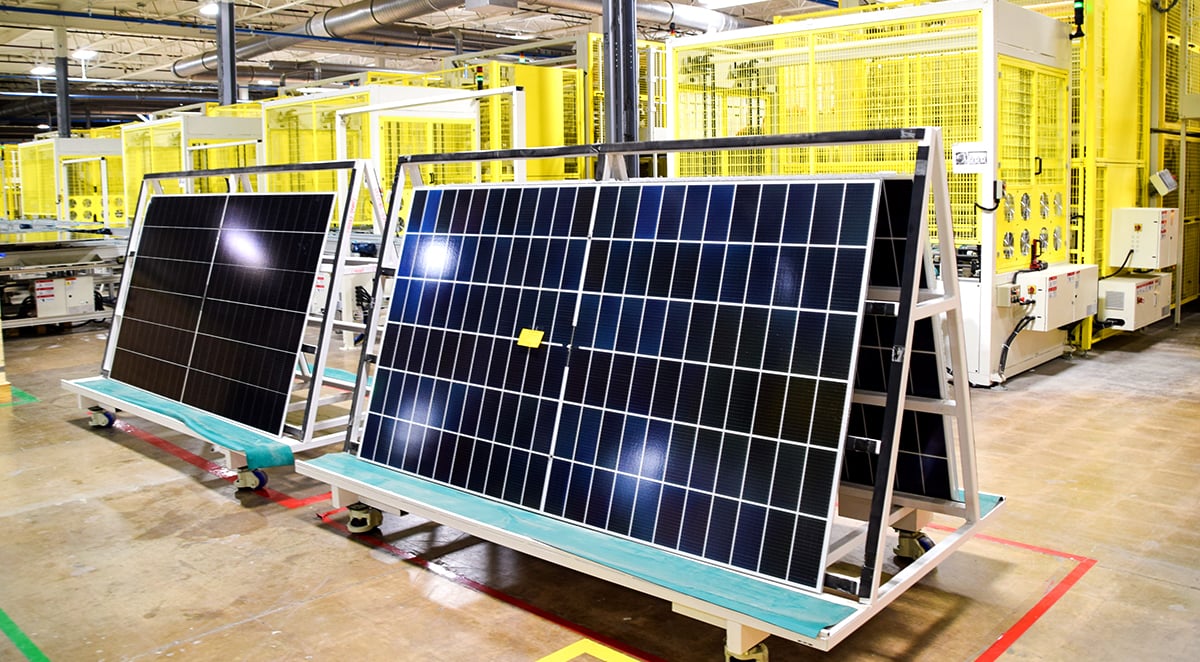
Solar manufacturing giant Canadian Solar has opened the first phase of a 6GW heterojunction technology (HJT) solar cell facility in Jeffersonville, Indiana.
Why it matters: Canadian Solar’s massive HJT scale-up means the efficiency gap between 'standard' and 'premium' is widening; your TOPCon sales pitch just got a lot harder.
Flick AI is a CRM for solar installers: the AI answers WhatsApp leads in seconds, builds proposals with automatic panel layouts and books the site visit. See how it works.
While European manufacturers like Meyer Burger are essentially fleeing to the U.S. for survival, Canadian Solar is planting a massive 6GW flag in Indiana. For the average installer in Lisbon or Berlin, this isn't just another factory opening; it is the definitive signal that Heterojunction (HJT) technology has reached the scale required to kill off the premium cachet of TOPCon.
The Efficiency Arms Race Just Got Expensive
We’ve spent the last two years listening to sales reps brag about 22.5% module efficiency on N-type TOPCon. That’s now the baseline. By scaling HJT to 6GW, Canadian Solar is weaponizing the technology’s superior temperature coefficient (-0.26%/°C) and higher bifaciality. In hotter climates like Southern Spain or Portugal, an HJT module will consistently outperform TOPCon by 3-4% in real-world yield. If you aren't factoring that into your PVSyst simulations for C&I clients today, you're leaving money on the table.
The bottom line: If you are pitching 'premium' systems, your customer is going to start asking why they should pay a premium for TOPCon when HJT—with its better degradation rates and better heat tolerance—is being churned out at gigawatt scale. Stop looking at HJT as a 'future' tech; it's your 2025 inventory reality.